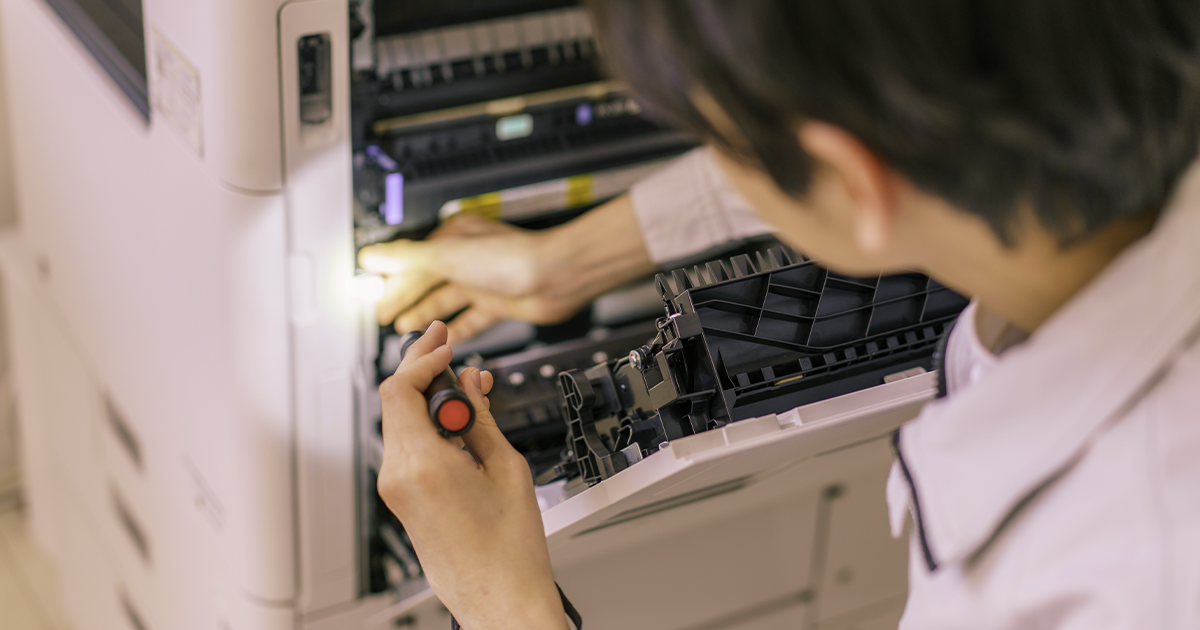






When a critical printer goes down, getting a quick response from your service provider can be reassuring. But a fast response doesn't always mean a fast repair.
For IT leaders, the question becomes, “How long will the printer actually be out of service?” Understanding the difference between printer service response time and printer service resolution time can help you evaluate Managed Print providers more effectively, set realistic service expectations and reduce costly downtime across your organization.
Printer service response time measures how quickly a service provider reacts after a printer issue is reported. Depending on the provider's service-level agreement, this may refer to acknowledging the service request, beginning remote troubleshooting, dispatching a technician or arriving onsite.
Because response time is easy to track, it's often highlighted as a key performance metric. For example, a provider may guarantee a four-hour response time and have a technician onsite within three hours. While this demonstrates responsiveness, it doesn't necessarily mean the problem has been fixed or that users can resume printing.
Printer service resolution time measures how long it takes to fully restore a printer to working condition after a service issue is reported. Unlike response time, resolution time includes the entire repair process, from diagnosis and troubleshooting to parts replacement and testing.
For example, a technician may arrive within four hours, but if a replacement part isn't available until the next day, the resolution time could exceed 24 hours. Because it reflects the total duration of the disruption, resolution time provides a clearer picture of how service performance impacts productivity and printer uptime.
A fast response time can create the impression of excellent service, but it doesn't always translate into a quick repair. A technician may arrive promptly only to discover a specialized part is needed, requiring a return visit. In other cases, a provider may count dispatching a technician or beginning remote troubleshooting as a response, even though the device remains out of service.
For IT leaders, the real concern is how long employees are without access to printing. Response time measures how quickly service begins. Resolution time measures how quickly the problem is solved. Until the printer is fully operational again, downtime and productivity disruptions continue.
When evaluating a Managed Print provider, it's important to look beyond a single service metric. While printer service response time shows how quickly a provider reacts to an issue, printer service resolution time reveals how long it takes to restore normal operations.
To gain a complete picture of service performance, ask providers about additional metrics such as first-time fix rates, average resolution times and repeat service calls. These measurements can help identify whether issues are being resolved efficiently or simply acknowledged quickly.
A provider that responds quickly but requires multiple visits may create more downtime than one that responds slightly later but fixes the issue on the first visit. Ultimately, effective service is measured not by how quickly help arrives, but by how quickly employees can get back to work.
Service-level agreements can provide helpful benchmarks, but they don't always tell the full story. To better understand a provider's ability to minimize downtime, ask questions such as:
The answers can reveal whether a provider is focused solely on meeting response-time commitments or on restoring productivity as quickly as possible. By evaluating metrics, organizations can make more informed decisions and set clearer expectations for printer service performance.
At Gordon Flesch Company, we believe service performance should be measured by outcomes, not just activity. That's why our Managed Print Services reporting focuses on metrics that help organizations understand both how quickly issues receive attention and how quickly devices return to service.
The most effective providers don't just respond quickly. They resolve issues efficiently, minimize downtime and help employees stay productive.
Ready to Improve Printer Uptime?
Learn how Gordon Flesch Company's Managed Print Services can help you reduce downtime, improve service visibility and keep your print environment running at peak performance. Contact us today to get started.